|
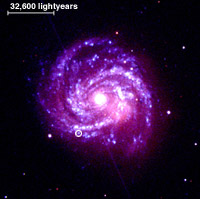
NASA broadcasted a conference about the discovery by Chandra observatory that could potentially be the youngest blackhole ever detected. This object is a remnant of the 1979c supernova in M100 galaxy (picture on the left; source: ESA), which was a star of 20 solar mases that exploded in 1979 and reached extremely bright luminosity (one of the brightest supernovae ever seen) in this process. This supernova got much more attention after many years when new observations showed that its brightness did not come down, which is what should normally happen.
What is not yet clear, however, is whether this object is really a blackhole or a pulsar wind nebula. Blackholes and pulsar wind nebulae have different X-ray spectra but scientists said during the conference that more observations need to be done so they could say for sure what the object is. At the moment the spectra analysis does seem to be very similar and we just do not know yet. If it was a black hole then this would be particularly interesting given the low mass of the star and it would be the first blackhole that we know the birthday of.