

01
Building in Slovakia
I studied mechanical engineering at Stredná priemyselná škola strojnícka in Zvolen. Before moving to the UK, I worked as a builder. These photographs show that part of my life: on the roof slab and with my colleagues on site.
Story
Before robotics, I worked on building sites in Slovakia. At 19, I moved to Plymouth with little money and barely any English. Since then I’ve studied, worked with robots and camera systems, photographed the sky, become a father, and built Project Tao.
01
I studied mechanical engineering at Stredná priemyselná škola strojnícka in Zvolen. Before moving to the UK, I worked as a builder. These photographs show that part of my life: on the roof slab and with my colleagues on site.

02
In Plymouth, I found work in a fish-processing factory. A chance conversation with Professor Simon Davies about astronomy and photography led him to suggest university. I went back to Slovakia to complete civil service and improve my English, then returned to Plymouth to study computing.

03
I worked full-time at night and studied for my BSc Computing full-time during the day. Alongside both, I took the University of Manchester’s distance-learning astronomy course, Life in the Universe, in 2006-2007.
I also took astrophotographs and later shared telescope observing sessions on Plymouth Hoe. Astronomy had a place of its own in my life, alongside computing. In 2008 I graduated with First Class Honours and received the Revell Research Systems Prize.
04
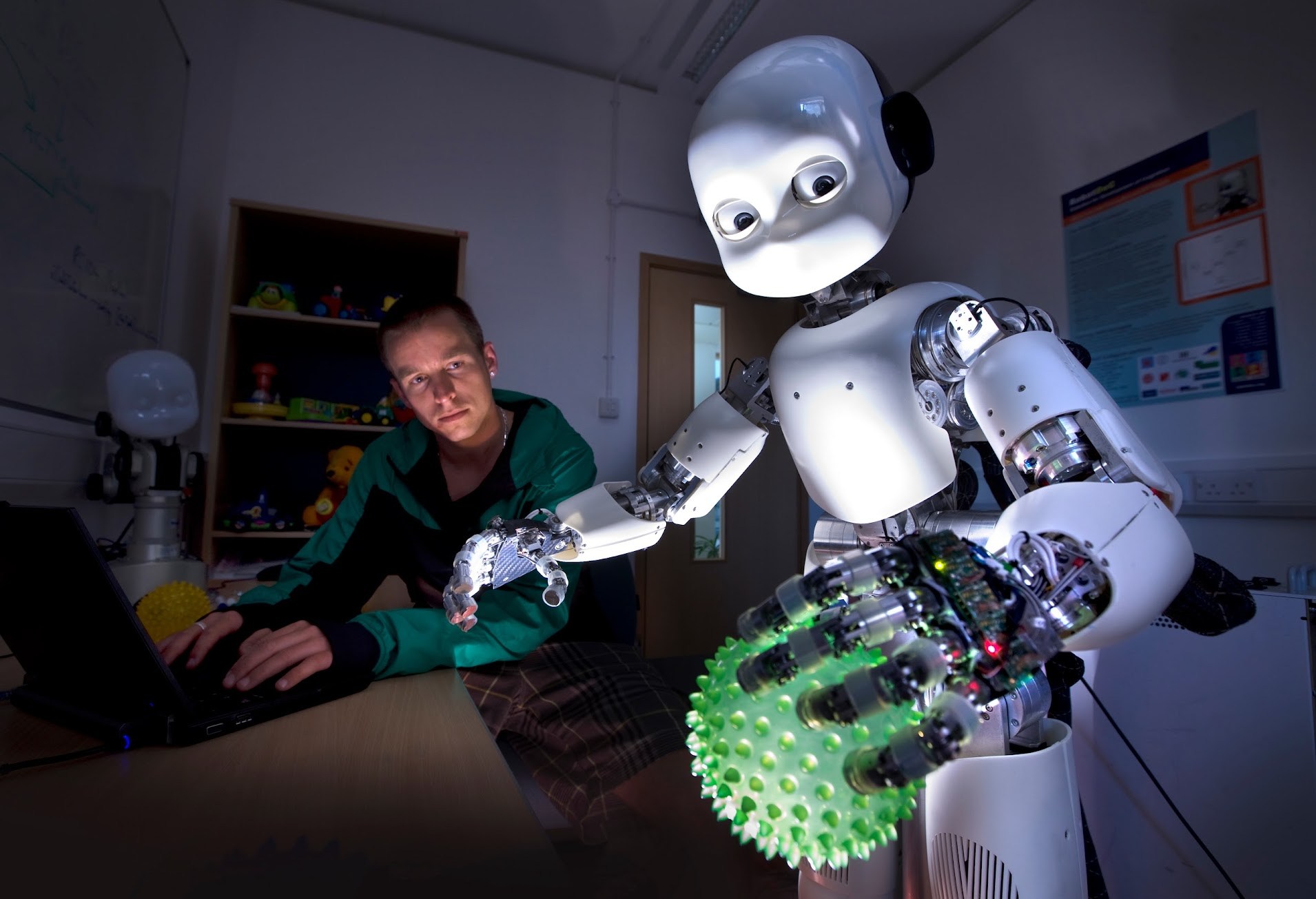
My final-year Mars rover simulator led to research with ESA and a PhD at Plymouth. In iTALK, I worked on how the iCub humanoid robot learns actions and language. I developed Aquila and used CUDA to make larger neural-network experiments practical; POETICON++ continued that work with the Plymouth team.
I was an early pioneer in applying GPU computing to cognitive robotics. Plymouth describes my 2014 thesis as the first investigation of GPU computing’s impact on that field. My supervisors were Angelo Cangelosi, Tony Belpaeme, and Davide Marocco.

05
With Angelo Cangelosi and Davide Marocco at Plymouth, I worked with ESA’s Advanced Concepts Team on evolving controllers for simulated Mars rovers. The ESA team included Christos Ampatzis, Dario Izzo, and Francesco Biscani. This parallel evolutionary-robotics study was separate from my CUDA acceleration work.
The iCub and GPU research led to an invited NVIDIA headquarters presentation in 2011 and a summer research internship in 2012. NVIDIA also featured the work in CUDA Spotlight, GTC material, and an SC11 keynote mention.

06
At TEDx Bratislava, I spoke about moving to Plymouth, working while studying, and the dream of building intelligent machines. I brought iCub and GPU computing into that story, then wrote about the experience on my website.
Watch the TEDx talk Read my original account
07
I joined Cortexica in February 2014 as a GPU Engineer and became Head of Innovation in June 2016. In October 2019 I joined AnyVision as Senior Innovation Engineer. That work has continued through Oosto and its acquisition by Metropolis.
I work on computer vision, edge systems, synthetic worlds, and spatial calibration: connecting what cameras see to shared coordinates in a physical scene.
08Family life
I’m Oliver’s dad, too. There is more to a life than the work: these moments with him belong here just as much as the projects.


A story carried through five generations
My great-grandfather Pavol Bučan left a written account of imprisonment, a death march, escape and his return home in 1945. His son Ivan, my grandfather, transcribed and edited it. My mother Odetta Peniaková kept that transcript safe for decades.
I made a documentary from the testimony they preserved. It ends with five generations of our family, reaching my son Oliver, who can now encounter Pavol’s story.
Watch the film & explore the family archive
10Now
At Project Tao, I’ve been turning rough land into an off-grid place with gardens, paths, structures, water systems, and solar energy. I work on its automation as well as the physical build. It’s a personal project, with planting, repairs, and plenty still to do.
Visit Project TaoFull chronology
Study, work, astronomy, research, and family life, with links to the original material.
I attended Stredná priemyselná škola strojnícka in Zvolen from 1999 to 2003, then worked as a builder before moving to the UK.
Building-site photographsI arrived in Plymouth with little English and little money, and found manual work. Professor Simon Davies encouraged me to consider university.
After returning to Slovakia to complete civil service and improve my English, I came back to Plymouth to combine full-time study with night work.
I worked full-time nights at Interfish while studying BSc Computing full-time during the day. My Interfish work dates from approximately 2004 to September 2008; the degree ran from 2005 to 2008. I also took astrophotographs and completed Manchester’s distance-learning course, Life in the Universe, in 2006-2007.
I graduated with a First-Class BSc and received the 2008 Revell Research Systems Prize as the highest-performing final-year BSc Computing student, before continuing into research.
I continued photographing the sky and sharing telescope observing sessions. The astronomy archive includes planetary images and photographs from public observing nights.
My research covered iCub action-language learning, neural networks, vision, and GPU acceleration. I completed the thesis in 2014, supervised by Angelo Cangelosi, Tony Belpaeme, and Davide Marocco.
I worked on parallel evolutionary rover research with the Plymouth and ESA teams. Separately, my iCub GPU work led to a 2011 NVIDIA headquarters presentation, CUDA features, conference material, and a summer 2012 internship in Santa Clara.
Our rover-control paper received the 2010 best paper award. In 2011, Aquila: Massively Parallelised Developmental Robotics Framework received the same recognition.
Alongside my research, I worked as a part-time Associate Lecturer, preparing CUDA classes and teaching and demonstrating GPU programming. I helped build the teaching infrastructure with Davide Marocco and the university team.
Teaching appointmentI spoke about Plymouth, robotics, GPU computing, and the dream of building intelligent machines.
I worked at Cortexica from February 2014 to September 2019, then joined AnyVision in October 2019. Across Cortexica, AnyVision, Oosto, and Metropolis, my work has developed from GPU and edge-camera engineering into synthetic worlds and multi-camera calibration.
I’m Oliver’s dad, too. Two photographs of us together have their own place in this story.
FatherhoodI’m building an off-grid personal project with gardens, water systems, structures, solar energy, and automation.
Go to Project TaoKeep exploring
More photographs, the technical work, and my writing in the voice of its time.
Legacy
I didn’t do this alone. Family, teachers, supervisors, collaborators, friends, and colleagues helped me along the way. They belong in this story too.
