Senior Innovation Engineer at Metropolis, working on computer vision, edge systems, and spatial intelligence. My background combines cognitive robotics, GPU computing, and applied innovation.
I joined AnyVision as Senior Innovation Engineer in October 2019 and continued through Oosto and its acquisition by Metropolis. My work spans applied computer vision, edge systems, spatial calibration, synthetic vision, and technical prototyping.
I led innovation work across machine vision, edge AI, mobile inference, and AR/VR prototypes, including Prism and OVERPaSS.
GPU Engineer – Cortexica Vision Systems
My parallel-computing work covered GPU/OpenCL/CUDA optimization, image-processing pipelines, deep learning experiments, and cloud and edge systems.
Associate Lecturer (GPU programming) – University of Plymouth
Part-time teaching alongside my research in Plymouth, UK. I prepared and taught CUDA classes, lectured and demonstrated, and helped establish GPU teaching infrastructure, including the NVIDIA CUDA Teaching Center, with Davide Marocco and the university team.
NVIDIA research internship – Santa Clara, California
I spent summer 2012 at NVIDIA after presenting GPU cognitive-robotics applications at its Santa Clara headquarters in 2011. The wider 2011-2014 activity includes CUDA Spotlight, an SC11 keynote reference, a GTC 2012 poster, and a GTC 2014 presentation.
PhD researcher, cognitive robotics – University of Plymouth
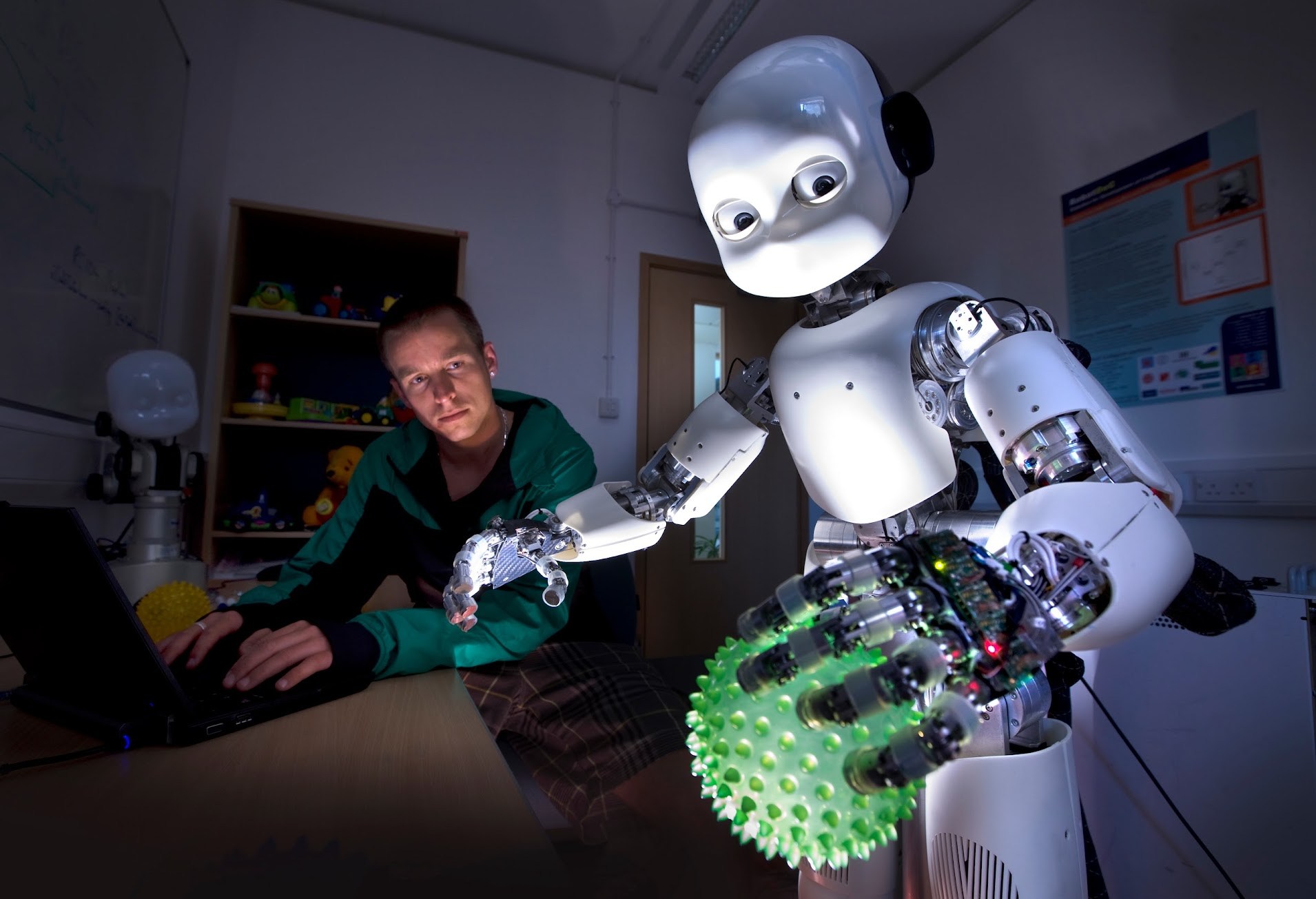
Research during my PhD, covering iTALK and POETICON++, iCub action-language learning, recurrent neural networks, Aquila, and GPU-accelerated robotics.
Mars rover research – University of Plymouth and ESA ACT
My final-year rover simulator led to Evolution in Robotic Islands. I worked with Angelo Cangelosi and Davide Marocco at Plymouth and ESA’s Advanced Concepts Team on parallel evolutionary robotics, separately from the CUDA work.
University of Plymouth. The university describes the thesis as the first investigation of GPU computing’s impact on cognitive robotics. Supervisors: Angelo Cangelosi, Tony Belpaeme, and Davide Marocco.
Alongside my research and professional work, I physically build and operate Project Tao, my personal off-grid project.
Cognitive robotics, action-language learning and neural networks
GPU/parallel computing and multi-GPU training
Camera intelligence, edge AI and embedded vision
Multi-camera spatial calibration and synchronized capture
IoT, device integration, Home Assistant and home automation
Local AI and server systems, voice and remote operations
Hands-on solar installation, lithium-battery storage and energy control
Off-grid self-sufficiency: water, irrigation and physical site construction
C++, Python, CUDA, OpenCL and OpenCV
Selected publications
A representative selection, not a complete bibliography. Explore my wider publication record on Google Scholar and DBLP.
Zhong, J., Peniak, M., Tani, J., Ogata, T., & Cangelosi, A. (2019). Sensorimotor input as a language generalisation tool: a neurorobotics model for generation and generalisation of noun-verb combinations with sensorimotor inputs. Autonomous Robots, 43(5), 1271–1290. https://doi.org/10.1007/s10514-018-9793-7
Broz, F., et al. (2014). The ITALK project: A developmental robotics approach to the study of individual, social, and linguistic learning. Topics in Cognitive Science, 6(3), 534–544. https://doi.org/10.1111/tops.12099
Peniak, M., Morse, A., & Cangelosi, A. (2013). Aquila 2.0 software architecture for cognitive robotics. In 2013 IEEE Third Joint International Conference on Development and Learning and Epigenetic Robotics (ICDL) (pp. 1–6). IEEE. https://doi.org/10.1109/DEVLRN.2013.6652565
Peniak, M., Bentley, B., Marocco, D., Cangelosi, A., Ampatzis, C., Izzo, D., & Biscani, F. (2010). An island-model framework for evolving neuro-controllers for planetary rover control. In The 2010 International Joint Conference on Neural Networks (IJCNN) (pp. 1–8). IEEE. https://doi.org/10.1109/IJCNN.2010.5596942